Leaflet Printing

The cheapest flyers available can always be found with a quick search on Google. If the cost is good from a particular printer, and the leaflet printing looks decent, most people will stop searching. James is always looking for a shrewd deal, that’s why his business is so successful. When he put his mind to printing full colour flyers, its really a surprise that he found a bargain. The budget for the business leaflets was tight this year and he had to find the cheapest flyer printing available without compromising quality.

After spending about 30min looking for flyer printers and trying to find the best leaflet printing deal, I eventually stumbled upon some affordable leaflet printing. The problem was that designing the promotional leaflets was going to cost 129 pounds! The money available for the leaflets printing just would not cover it.” He explained. He had some creative skills and knew that he could probably design the full colour leaflets himself with a bit of guidance. After searching around the Internet, he found out the following:

Design Application

He told me, “You need to start by finding a good application to design your flyers printing on. Don’t rush this, or else it could cause you a lot of hassle later.” The easiest software to use to design your leaflet is desktop publishing software such as Word. Most printers however, will require you to send your leaflet design in PDF format. You cant do this with Word. Photoshop is usually used to design the most impressive flyer printing.

Putting your Leaflet in Printing Format

“To design your flyer for printing using Photoshop, set the canvas size to the correct size of the leaflet, plus bleed. When the flyer printing company has printed your flyer, they will be on a big sheet with lots of tother leaflet printing. So it is important that you leave a little excess around the edges of your design to prevent them from cutting into it too much – this is bleed. About 3mm is the average amount of bleed required on a leaflet,” he explains. Therefore, if you decide to print flyers that are A4 (210x297mm) then you need to add 3mm more around the edges of your design. So the total size will be 216x303mm.

The colour scheme for your full colour flyers should be set to CMYK not RGB. You tv screen uses the colours red, green, blue to create the image of your leaflet, this is known as RGB. CMYK or cyan, magenta, yellow, black, are the actual colours of the ink used in leaflet printing. Setting the colours to CMYK may make the colours of your leaflet look slightly darker on the monitor, but it will look much better when printed.

To get the best quality flyer printing, most leaflet printing companies will request that you set the resolution to 300dpi or dots per inch. You need to be aware that your monitor only shows resolution at 72dpi, so whilst your leaflet may look good on the screen, it could look pixelated when it is printed.

“When you send your leaflet design to the printers, ask them to send you a proof by email, you can check that the flyer looks correct before its printed. If there are any problems with you leaflet, your leaflet printing company will come back to you and tell you to change the design. Remember that if you don’t feel confident enough to design for leaflet printing or flyer printing than you can always ask your printer to do the design for you, but be prepared for a fee!”

How to Start an Online Print Shop (Video)

I know many people in the printing industry, or who are interested in becoming a part of it, are interested in starting online print shops.

The benefit of running an online shop is that you can create a highly scalable business, with tons of opportunity to grow using digital marketing strategies.

The age of Ecommerce is here! With the appearance of Web2Print and the global move towards doing business over the internet, online sales have become a large part of modern printing businesses.

Here’s a nice video I found mainly focused on starting a screen printing t-shirt business online, but the principles hold true for any online shop!

Let me know what you guys think in the comments.

How to Price Your Screen Printing Jobs

The most important factor which is going to make or break your screen printing business is your pricing. You need to be sure that what you are charging is covering your costs with a healthy profit margin on top, otherwise you’re at a serious risk for failure.

The good news is that once you know how to properly price your screen print jobs, it’s very easy to implement correctly.

Every screen printing business has different costs associated with their operations, so there is no one answer for how much to charge for each job. Instead, you must follow guidelines to calculate how much you need to charge in order to be profitable while pricing competitively enough to win customers.

In order to make the proper calculations, you must determine how much of your costs are going to your screen printing jobs themselves, and how much is required to cover your business overhead.

Here is an excellent resource with all of the equations you need to determine this.

Once you have followed along with the equations on that page and have your screen printing job costs figured out, add a markup that leaves your screen printing business profitable. It is better to start lower, as the industry is very competitive and you want to be sure you aren’t losing business to competitors who price lower.

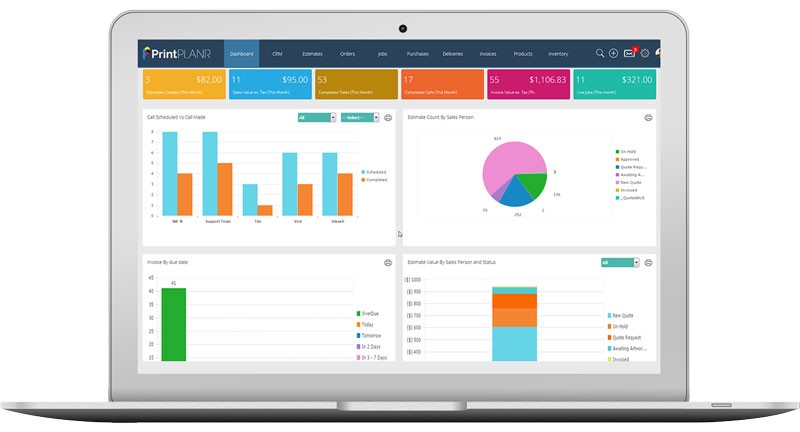
Print MIS Can Help You Gain Long-Term Benefits For Managing Your Print Shop

It’s no secret that technological processes are reaching new operational heights at increasing rates. We live in a time where software is being developed to carry out virtually any task you can think of across all kinds of industries. People are able to be much more productive and generate more with their time thanks to this. This is changing the way business is done and adds a completely new aspect to remaining competitive in any respective industry. An example which I have some personal experience with is seen in the printing and graphics industry, with the widespread use of print MIS (management information system) software. Long gone are the days when you need a full team of experienced printers to be able to run your print shop smoothly. With the available software for managing print shops, any one of your team members can have the ability to complete formerly complex processes. Functions like print estimating, order management and proper handling/nesting of substrates are no longer reserved for the most knowledgeable members of your staff.

The software solutions which have began to appear in recent years have changed the print industry forever. Print MIS software has become extremely popular, and its use is only becoming more widespread. And that comes at no surprise: print MIS systems assist in the coordination and proper management of every process associated with running a print shop. The wide range of features boasted by these powerful tools makes their adoption and implementation a no-brainer for shops with any desire to improve their workflow.

Another huge benefit of using print management software is the reduction of risk for making errors as a result of data re-entry or poor organization. Any printer knows the pain and cost with having to redo an expensive, and time-consuming, custom job because of a clerical error. And to top it off, most print MIS systems come equipped with tools for effective customer communication which will do wonders for building relationships with them.

With all of the available solutions, it’s important to demo a few different systems to work out which is best for your business. Solutions such as PrintPLANR, Ordant or Printmatics all offer great products and each have their own set of advantages. Determine what’s important for your business to come to a decision on which you’ll go with.

To sum up, any print shop owner or production manager should look into adopting a Print MIS (if they haven’t already). The chances of being dissapointed with what’s available are slim to none. The impact these tools can have on a business is huge, and they should at the very least be given a close look. Print MIS is changing the way print shops are being managed, and printers too late to adopt them will surely fall behind those who weren’t.